

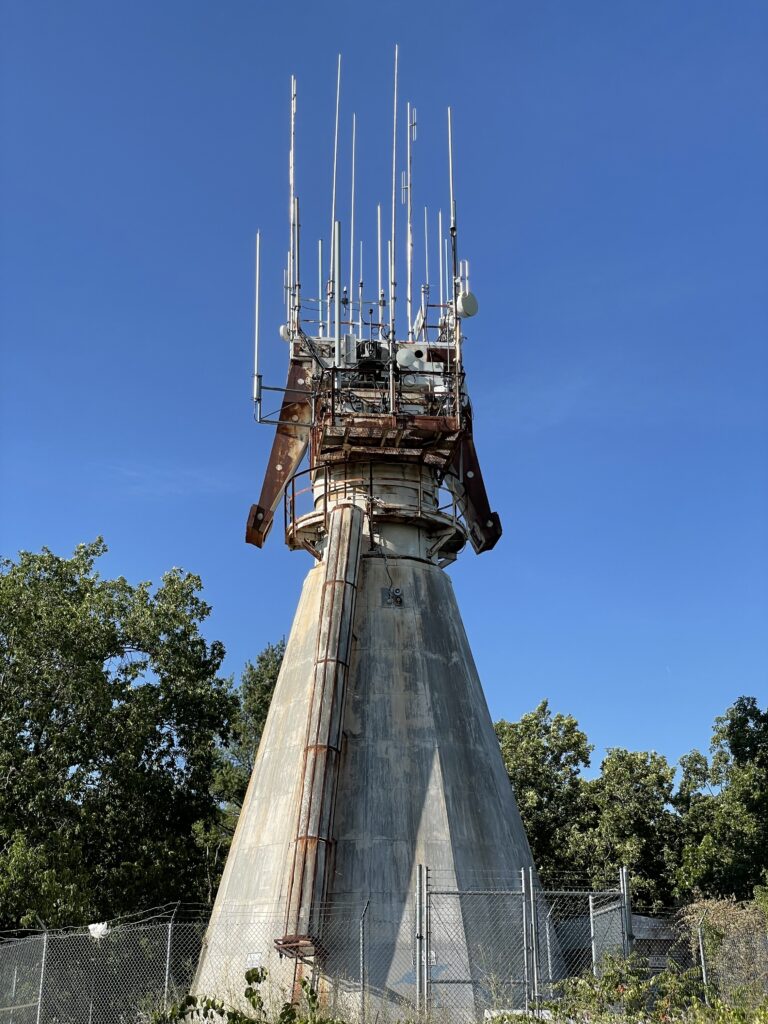
Atop Prospect Hill in Waltham sits a bit of a monstrosity: a concrete pillar topped by rusted metal, surrounded by a dilapidated chain-link fence and rather resembling a pincushion with the myriad antennas on top.
It’s easy to discover that the structure was built by the Air Force and formerly supported a radar setup, and that it’s now home to various public safety repeaters, plus the Waltham ARA‘s equipment, whose logo depicts the structure.
But a search to find much more detail quickly runs aground. The lack of information only further piqued my curiosity. Here’s what I’ve been able to find.
Early History
According to the Waltham Land Trust, Prospect Hill was first made a city park in 1893, spanning 250 acres.
A lot more information comes from Elizabeth Lowe’s Prospect Hill Park: Its Creation, Decline, and Renewal, which seems to exist now only as a PDF on Wayback Machine. A 60′ fire tower first went up on Prospect Hill in 1917, and was moved to a lower site atop Little Prospect in 1963 due to the military installation atop Prospect Hill (more on that shortly). The new fire tower became home to a number of repeaters, including the city and Waltham ARA. At some point the fire tower was apparently set on fire.
Prospect Hill was apparently home to a ski area for a while as well.
The Antico Tower
From 1962 until 2017, the park was home to a traditional radio tower, eventually growing to about 300′ tall (ASR 1061358). It was built by the Anticos, a construction company (which now holds a large amount of real estate as well) in the 60s, first as a 75′ tower but undergoing several extensions.
A number of photos of the existing tower are still around. Some photos on the Critical Towers company site tell the first part of the tale: the well-worn Rohn 80 tower was being eyed for replacement by a basically-identical tower a few feet over. In 2015, the zoning board approved the project, but drew the ire of the building inspector and the Parks and Recreation Department, as well as the Waltham Land Trust, with the argument being that the tower was never really built legally in the first place, being a commercial structure on land zoned residential, and with guy wires and an access road located on city property. It was ultimately dismantled in July of 2017.
It’s a shame, because it was also home to an impressive array of filters inside for a receive multicoupler, and equipment up there had a great coverage footprint.
As a footnote, one of the tower tenants depicted above was a widely-used T-band trunked system. When the tower came down, it migrated to the roof of the Prudential building in Boston, but fell victim to the T-band freeze, unable to expand its coverage footprint. An attachment (PDF) to the license modification hints at the tremendous power reduction that was required, dropping from 300 Watts ERP to 20 Watts on the LTR system’s home channel, and from 400 to 60 Watts on two others. (I wonder if, now that T-band is saved, they will be able to increase their power?)
The Air Force Installation
This is the bit that really piqued my interest. What exactly was this thing for, and why is there so little information on it?
It doesn’t seem that the answer was that it was classified or otherwise hush-hush. Lowe notes:
Circa 1963, the Air Force added a large antenna to their facilities. This antenna included a 30 foot wide parabolic reflector dish that sat atop a 40 foot high tower. It was used to monitor radio emissions from the sun. This would allow the Air Force to study sunspot activity and solar storms which can be dangerous both to aircraft and space vehicles. (p. 12)
It turns out that there’s simply not much written about it, and that’s a shame. I eventually found, through Google Books, a short book called Earth-to-Space Communications at Millimeter Wavelengths, dated 1965. A deeply scientific text published by the Air Force Cambridge Research Laboratories, it might not be terribly appealing to most people, except that page 24 includes a photo of the newly-constructed structure, described as the “29-Foot Millimeter-Wave Antenna,” and page 25 describes it as operating at 35 GHz and having a gain of 66.5 dB.
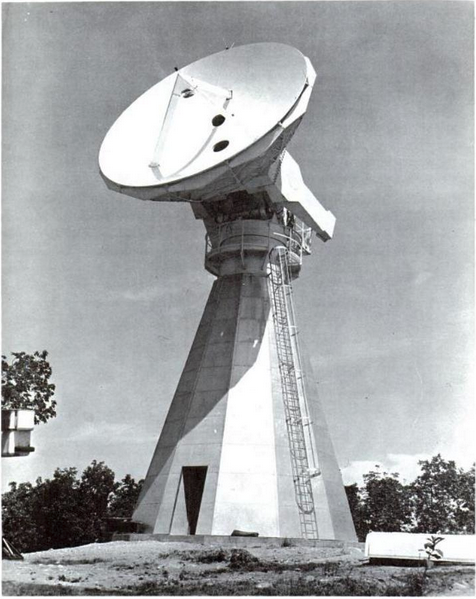
Lowe notes that the top of Prospect Hill (specifically the higher peak, Big Prospect) was leased to the Air Force starting in 1951, with the above structure going up in 1963. They would remain on site until 1997, but returned in 2000-2001 to clean the site up. The facility was apparently referred to as the Prospect Hill Radio Observatory.
The setup gets a brief mention in the March 1967 edition of Electronics (PDF), which describes what sounds like the Stockert Radio Telescope in Germany before mentioning the Waltham one:
Similar work is being done in the U.S. Under an Air Force sponsored program, the Prospect Hill Radio Observatory at Waltham, Mass., has plotted a number of sun temperature readings using a radio telescope operating on an 8.6-millimeter wavelength and having a 29-foot-diameter antenna dish. By coordinating solar research with observatories around the world, it is possible to provide round-the-clock forecasts as the sun moves across the sky, says Otto H. Nachenberg, the Bonn institute’s technical director. But so far the Waltham and Stockert installations are the only ones built for this purpose.
Other publications now available online documenting the research (but not the site history itself) are Radiometric Observations of the Planets Jupiter, Venus, and Mars at a Wave-Length of 8.6 mm from 1967, and a collection of spectroheliograms published in 1971.